How to track AI search citations across ChatGPT and Perplexity
A visibility score tells you that something changed. It does not tell you which page an assistant read, which competitor it named instead of you, or what your page is missing. This is the method for keeping that evidence: how to sample, what to record, how to count, and how to turn a missed citation into a fix another team can check.
By CiteGraph · Updated 2026-09-15 · Prices checked on the vendors’ own pages
This guide is about the evidence behind each citation. The statistics of the measurement itself, sample sizes and error bars with worked examples, are in How to measure brand citations in ChatGPT and other AI assistants. The screenshots are from CiteGraph running on its own domain, where it is named in 0% of answers today.
How should I sample buyer questions across AI engines?
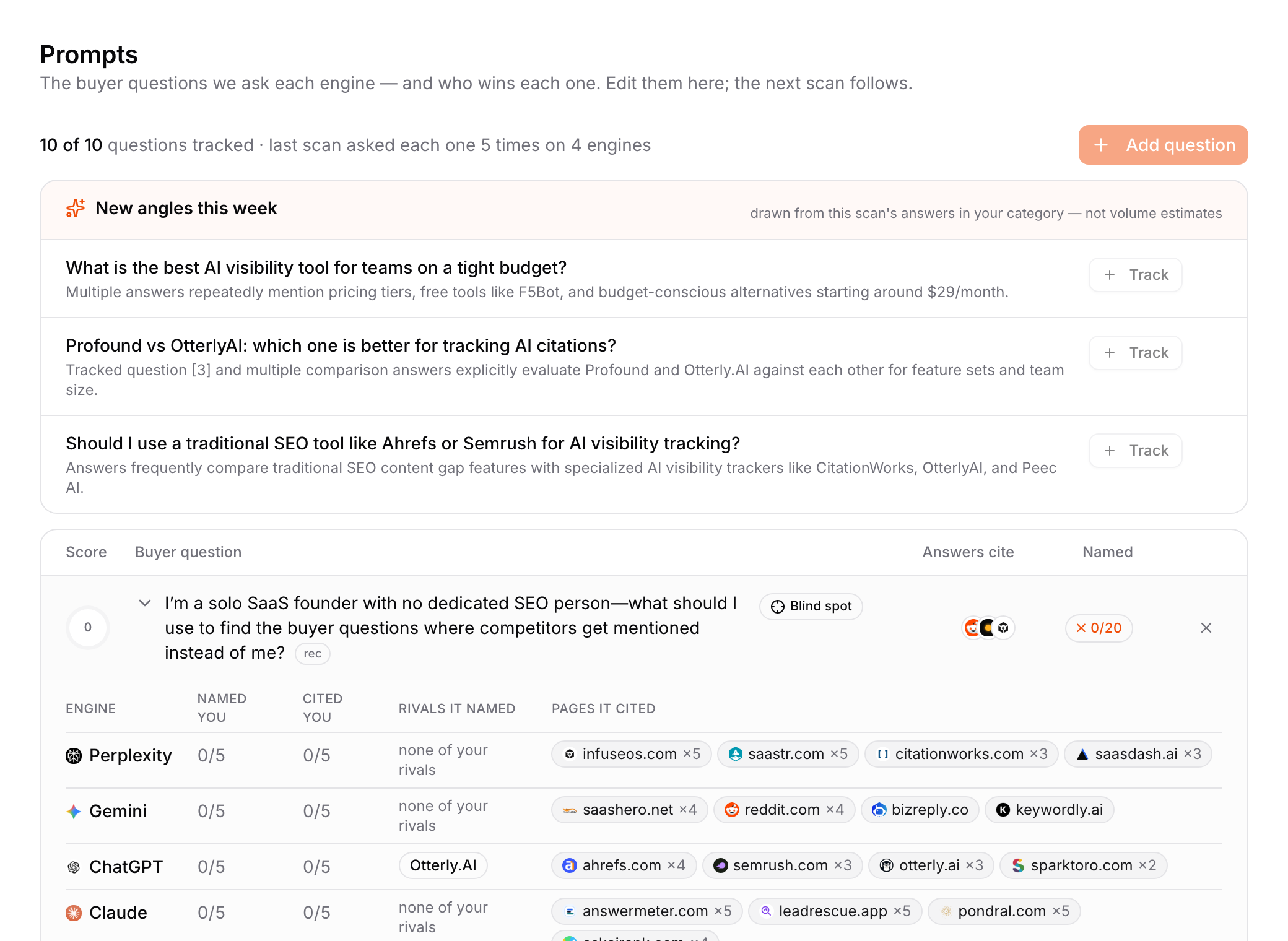
Start with questions real buyers ask, including comparison, alternative, pricing and use-case questions, rather than arbitrary prompts. For every observation, record the exact prompt, the engine, the run count, the named count and the cited count. One answer is an anecdote; repeated runs show how often an engine names or cites a brand across the same question. Keep records by engine instead of merging them into one visibility score, because ChatGPT, Perplexity, Claude and Gemini can produce different answers and citations.
A practical sample has ten buyer questions per product, so comparison, alternative, pricing and use-case intent all have room in the same measurement set. Compare the count of runs that named you with the count that cited your page, then keep those observations separate for each engine. If a count changes by one run, check the margin of error before calling it a trend; a small movement inside the measurement spread is a detail of the measurement, not evidence that the underlying result changed. When you compare scans, keep the question set, the engines and the run design fixed, so repeated-run variation is not confused with a change in visibility.
CiteGraph’s first scan mines comparison, alternative, pricing and use-case questions from your site, then asks each one 3 to 5 times on each of four engines, with named and cited counts stored per engine.
How do I trace an AI citation to the exact source page?
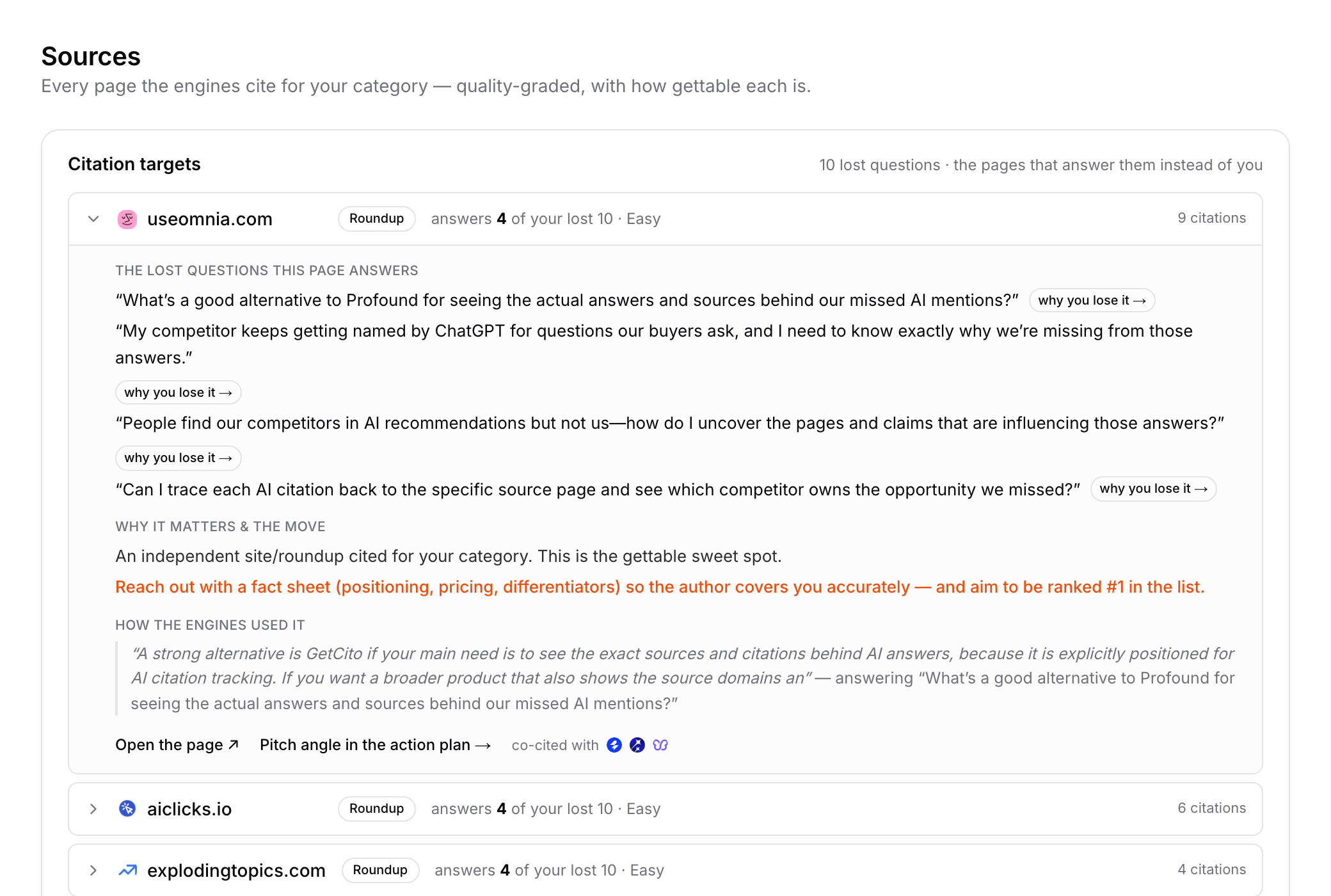
Record every cited URL, not only the domain, and preserve the full answer beside that source so someone can inspect the citation in context. A named mention tells you that an engine included a brand in its answer; a cited page tells you which source supported the answer. Keep both, because being named is not the same as being cited.
Inspect the page type as well as the URL, because an answer may rely on a competitor product page, a review, a discussion or a news article. Judge relevance by asking whether the cited page addresses the same buyer question, supports the claim made in the answer, and gives the engine usable evidence for it. A relevant page matches the answer’s subject and claim closely enough that a reviewer can explain why the engine used it. If a cited page answers an adjacent question, label that distinction in the record rather than treating its appearance as proof that it supports the question you tested. A page-level record is what lets you tell a competitor domain that appears often from the specific article or product page that actually gets cited.
The useful inspection record is the verbatim answer, the prompt, the engine, the highlighted mention and the cited page, not a score detached from its evidence. CiteGraph stores every answer that way, and its Sources screen lists every page the engines cite for the category, graded for quality and for how gettable each one is.
How often does each AI engine cite my brand and my competitors?
Calculate the named rate as the share of repeated answers that name a brand, and the cited rate as the share that cite a page for that brand. Report both by engine, with the underlying counts, the trend direction and the margin of error. The denominator is the repeated answer set for that buyer question and engine, not a traffic total, so the rate stays tied to the test you ran. Do not treat a small movement as a real change when it sits inside the margin; a chart that wiggles tells you nothing.
Read the two rates together, because being included in an answer does not establish that your page supplied its evidence. A brand named in 4 of 5 runs has a different measurement story from a brand named in 1 of 1 run, even though both contain a named answer. Compare changes across the same question, engine and run design before changing a page: a different question set or a different engine can move the result without proving that the page itself changed. Write down what changed between scans before interpreting the chart, including the question set, engine, run count, named count, cited count and margin of error. In CiteGraph, the dossier keeps the headline rates with their margins instead of replacing the underlying observations with a single score.
How do I find the competitor pages behind citations I missed?
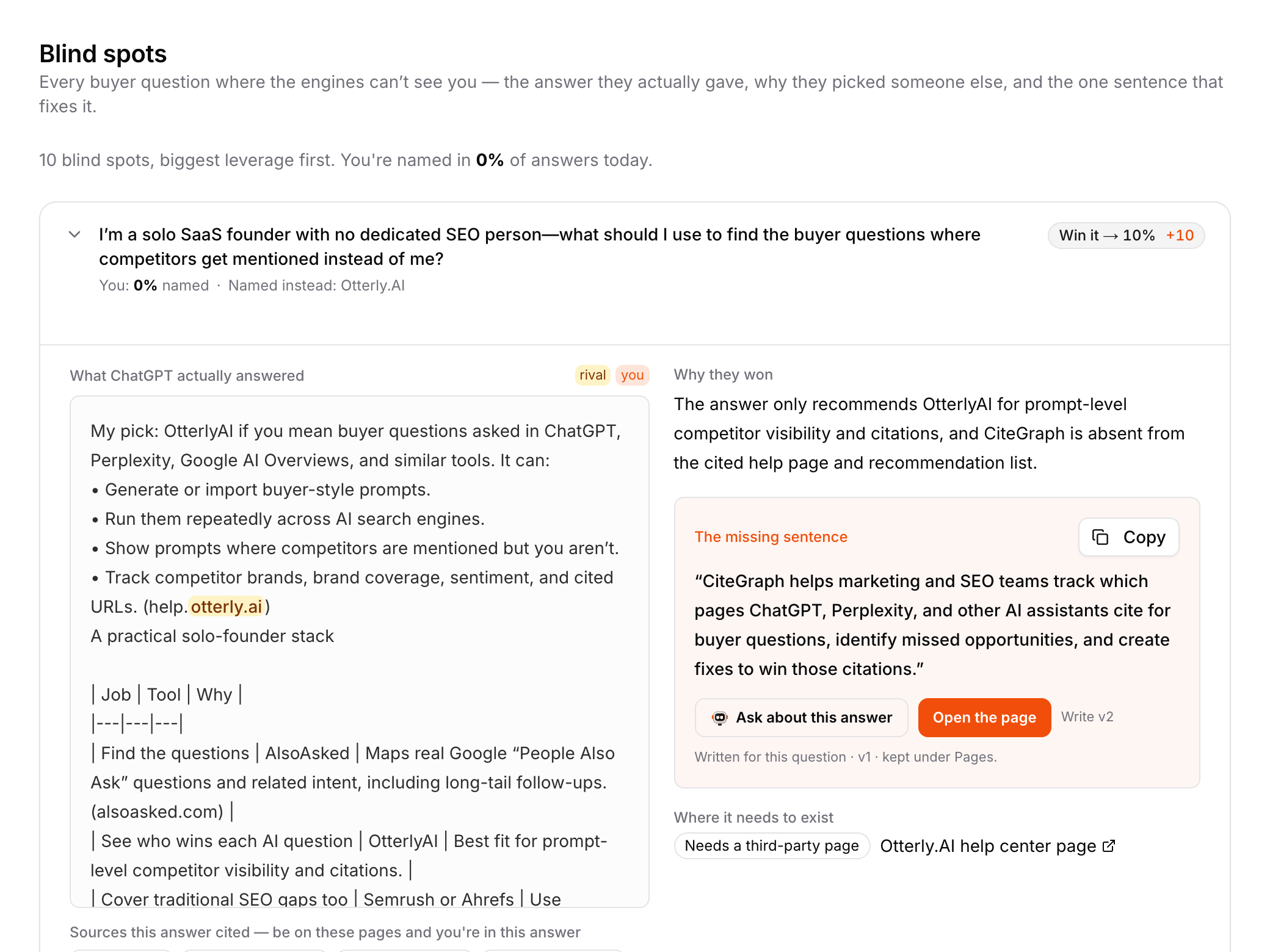
Filter for the buyer questions where your brand is absent and a rival appears, then attribute the opportunity to the rival and the exact page the answer used. Separate the competitor named in the answer from the page that supplied the citation, since they can be different sources. Add the missing sentence to the gap record before assigning the fix.
Rank the gaps by the importance of the buyer question, the citation frequency and the likely impact before assigning writing or technical work. Source-page relevance is part of that ranking: a page that directly answers the lost question and supplies the winning claim deserves closer inspection than a page merely mentioned in the same answer. Write down whether the winning page is a product page, a review, a discussion or a news article, then compare its evidence with the missing sentence rather than copying its format. A domain-level pattern is not enough for an action plan; identify the individual page, the buyer question it answers and the claim that made it useful to the engine. If the cited page supports only part of the answer, record that narrower evidence instead of copying a broader claim into your own page.
CiteGraph’s Blind spots screen does exactly this for every lost question: the full verbatim answer, the rival that won, the page it leaned on, why the engine chose it, and the one sentence missing from your page.
How do I turn a missed citation into a real fix?
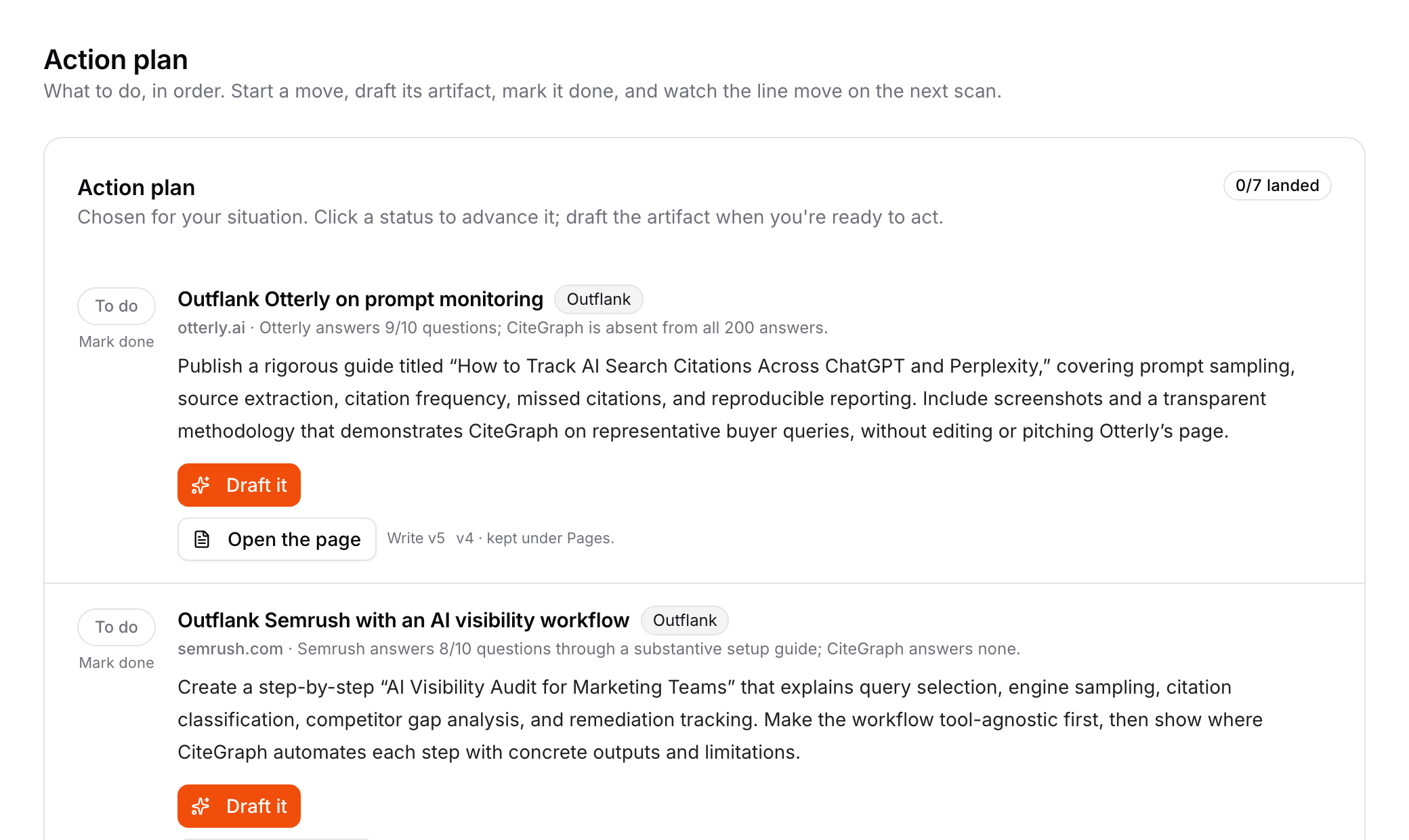
Judge each gap by the buyer question’s importance, the citation frequency, the source page’s relevance and the missing claim before choosing an action. Name the question, the winning page, the evidence and the concrete content move in the action record, then write the missing sentence in the form your page can support. A paste-ready fix states the buyer question it answers, the claim your page needs and the evidence behind that claim; it is specific enough to place on a page without sending the team back to a vague instruction such as “improve content”.
Use the winning page to understand the evidence pattern, but use your own facts for the final wording. A rival’s claim can show what is missing without proving that the same claim is true for your business. Turn the gap into a concrete edit by specifying where the sentence belongs, which buyer question it answers and which supported fact it must add.
CiteGraph’s Write the page reads the verbatim answers, the winning pages and your own pages, lists the engines’ criteria, the winning claims, your facts and the gaps, and then drafts. Every sentence in a finished draft can be traced to a fact on your site, a claim on a winning page or an engine answer; a claim nothing supports becomes a placeholder for you to fill rather than an invented fact.
How can I report citation results so another team can reproduce them?
A reproducible report records the prompt list, the engines, the run count, the verbatim answers, the cited URLs, the named and cited counts and the margins of error. Keep a methodology box beside the results with the question set, the engines, the run count and the rate definitions, and keep those definitions the same across reports, so a later reviewer can tell whether a changed result reflects new answers or a changed calculation.
Record what changed between scans, including the question, engine, run design, named count, cited count and margin, so a reviewer can separate a real movement from repeated-run variation. Keep the plays with the lost answers instead of exporting only a score, because the action depends on the rival, the cited source and the missing sentence. A reviewer should be able to move from a headline rate to the underlying answer, from that answer to the cited page, and from the page to the proposed fix. CiteGraph’s dossiers carry all of that, are shareable by link, and are white-label on Scale.
Which AI citation tracking tool fits this method?
Compare tools on exact source-page tracing, competitor-gap analysis, missed-opportunity attribution, verbatim answer context, engine coverage and a way to act on citation gaps. Source-page tracing answers where the citation came from; competitor-gap analysis answers which buyer questions your brand missed; attribution connects that missed question to the rival page that owns the cited source. Verbatim context keeps the prompt, engine, answer and cited sources together, which makes a result inspectable rather than only numerical. The table uses each vendor’s own published description; “not published” means we could not find the claim on their site, not that the feature is absent.
| Tool | Exact source-page tracing | Competitor-gap analysis | Missed-opportunity attribution | Verbatim answer and citation context |
|---|---|---|---|---|
| Otterly.AI | not published | not published | not published | Response-by-response data and citation detail; prompt not published |
| Profound | not published | Competitor appearance analysis; missed prompts not published | not published | not published |
| Semrush | Cited pages and citations; exact URL not published | Topic and prompt gaps where rivals are mentioned and you are not | not published | not published |
| HubSpot | not published | Competitor benchmarking | not published | Citation analysis and AI mentions; full answer not published |
| CiteGraph | Every cited source and citation target | Every question where a competitor appears instead | Rival and cited page | Full answer, engine, brand mentions and cited sources |
Prices and plan limits for the paid tools are compared, with dates, in AI search visibility tools compared.
What this method cannot tell you
Whether an engine’s claim about a product is true; only that it made it, attributed to that engine and that run. Whether a cited page will still be cited next week; engines change their sources without notice, which is why the measurement repeats. And anything about answers gathered through a scraped chat session rather than an API, because those sessions carry history and personalisation the method cannot control for.
Common questions
Can I trace an AI citation to the exact source page?+
Yes, if the tool keeps the cited URL rather than only the domain. CiteGraph stores every answer verbatim with its engine, the brand mentions highlighted and each cited source, so a citation can be opened and read in the context of the answer that used it.
How many times should each buyer question be asked?+
At least three times per engine, five if you can afford it, and always through the engine's API with web search on. CiteGraph asks each question 3 to 5 times on ChatGPT, Claude, Gemini and Perplexity and prints a margin of error on every rate.
What is the difference between being named and being cited?+
Named means the product appears in the answer's text. Cited means a page on the product's own domain is among the sources the answer used. They diverge constantly, so record and report them separately.
How do I know which competitor owns a citation I missed?+
Filter for the buyer questions where a rival is named and you are not, then open the page the answer cited. CiteGraph's Blind spots show each lost question with the verbatim answer, the rival that won, the cited page and the sentence missing from yours.
Can citation results be reported so someone else can reproduce them?+
Yes, when the report keeps the question set, the engines, the run count, every verbatim answer with its cited URLs, and the named and cited rates with their margins. A CiteGraph dossier carries all of that and is shareable by link.
See which pages answer your category — and what they say about you.
Check your site →