How to find the pages behind competitor AI recommendations
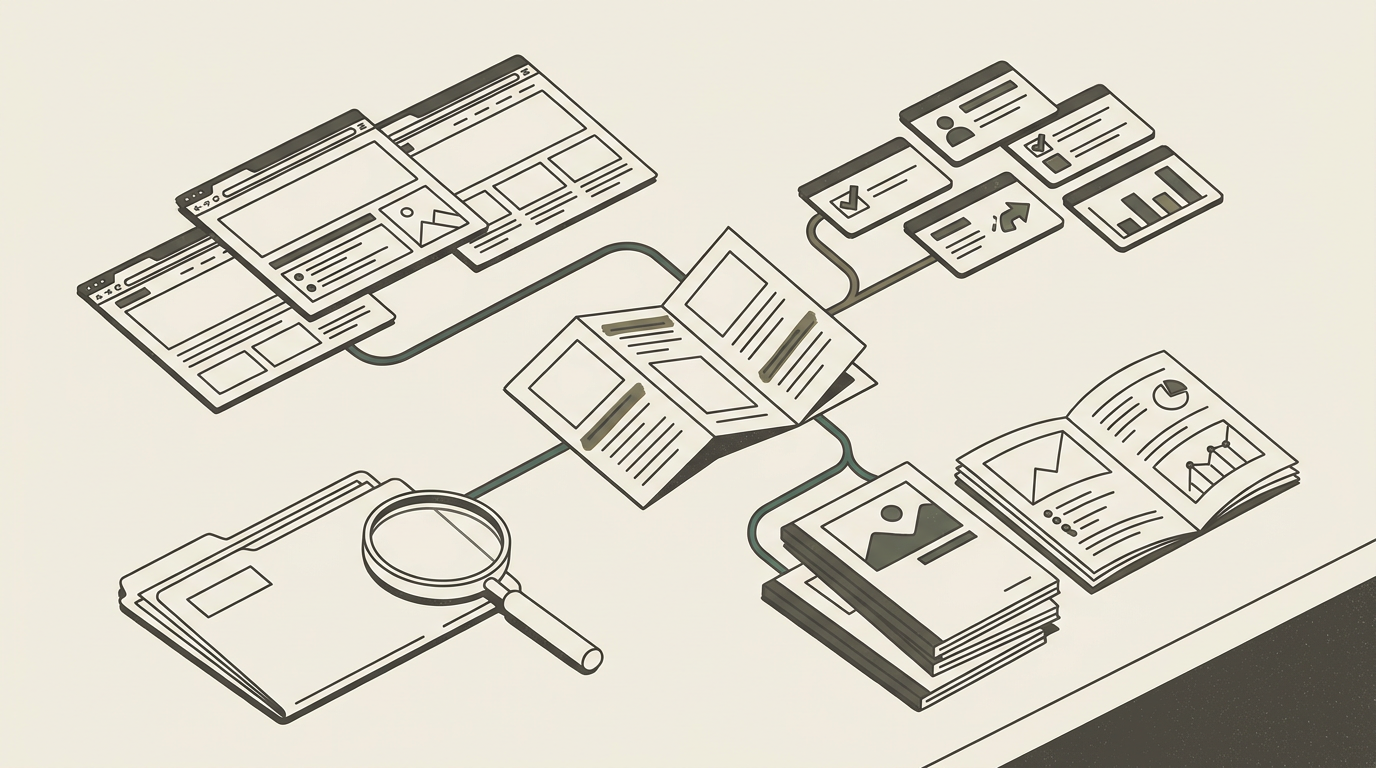
Start by saving the complete AI answer, not the competitor name alone. Then open every cited source, map the recommendation to the claim it supports, and repeat the same buyer question across engines and runs.
That is the practical answer to “How do I find pages behind competitor AI recommendations?” The rest of this guide gives you a repeatable route from a lost mention to the competitor source pages, claims and third party evidence influencing the answer.
What should you save before you analyse the answer?
Ask the question a buyer would ask, in the wording they would use. Include comparison, alternative, pricing and use case questions rather than a list of target keywords. The answer shows what the buyer needs to decide.
Record the engine, date, exact prompt, full answer and every citation. Preserve the wording before anyone edits the prompt or reruns it. The competitor may appear in the prose, in a table, or only in a linked source.
Run the question more than once. One answer is an anecdote. CiteGraph runs each tracked question 3 to 5 times on each of 4 engines and prints a margin of error on every rate. That does not remove variation. It shows whether an apparent lead is larger than the uncertainty around it.
Keep two counts separate:
- How often the competitor is named.
- How often a page is cited to support the answer.
These rates call for different fixes. A brand can be named without a useful citation, while a third party page can influence a recommendation without mentioning your company.
CiteGraph stores every answer verbatim with the engine, full text, highlighted brand mentions and each cited source. Its blind spots capability focuses on answers where AI names a competitor instead of you, including the winner and the cited page. See what is inside the product, page by page for the recorded fields.
How do you separate the answer from the source page?
Read the answer as a set of claims. Mark the sentence that names the competitor, the sentence that describes its capability, and the sentence that connects that capability to the buyer's use case.
Then classify each cited page. It may be a competitor product page, comparison page, listicle, review, community discussion or another page type. The type matters because the action changes. A product page may need a precise capability statement, while a third party list may require evidence outside your site.
Open the citation and copy the relevant passage into your notes. Record the page title, URL, publisher, date if shown and whether the claim is supported by the page itself or by another source it links to. Do not infer a source that the answer does not show.
RunOctopus describes the process plainly: “Look at the cited competitor pages and reverse-engineer their structure: what comparison do they make, what specific claims do they state, do they have an FAQ section, what schema is in the page source.” Its published guide also puts it plainly: “AI systems extract and cite specific, checkable statements.”
Use a short record for each recommendation:
| Field | What to record |
|---|---|
| Buyer question | The exact prompt and intended use case |
| Recommendation | The competitor name and wording around it |
| Claim | The capability or comparison supporting the recommendation |
| Source page | The exact URL cited by the engine |
| Source type | Product page, comparison, listicle, review or community page |
| Your gap | The missing, unclear or unsupported answer on your site |
Which page actually earned the citation?
Start with the URL the engine displays. If it is a competitor page, inspect its references, customer evidence and linked reviews. If it is a listicle or review, identify the claims it makes and check whether those claims recur elsewhere.
Do not assume that the most visible competitor page caused the recommendation. Several pages may support the same statement, and the answer may combine them. A comparison article can supply the category framing while a product page confirms a capability, but the displayed citation is still the first piece of evidence to record.
Visible recommends checking search results to find influential pages: “Whose pages dominate the first page? Those are the pages the AI is reading.” That is a discovery check, not proof of causation. The AI answer and its displayed citations remain the evidence for the observed recommendation. See Visible's published guidance for the original wording.
For each supporting page, record the buyer decision, exact claim, evidence and relationship to the cited page. Then ask whether your site can answer the same decision with facts it can support. You are not trying to reproduce a rival's wording. You are making the buyer's decision answerable.
CiteGraph's Sources screen lists pages AI engines cite for a category, deduplicates them, grades them for quality and gettability, and identifies citation targets for questions you lose. That turns a collection of links into a source map.
A citation is evidence, not proof.
Can you see the method in one worked example?
The following is an illustrative scenario, not a recorded customer result. Say the buyer question is “What is the best AI visibility tool for founders?” An answer names fictional competitor SignalTrack and cites a hypothetical listicle called “7 AI visibility tools for startup founders.”
Line one: save the complete answer, including the sentence that says SignalTrack is suitable for founders and the URL of the listicle. The competitor name alone is not enough.
Line two: classify the cited page as a listicle. Do not mark SignalTrack's product page as the primary source simply because the listicle links to it.
Line three: copy the listicle's reason for including SignalTrack. Suppose it says the tool tracks buyer questions and shows cited sources. Those are the claims to inspect, not a general conclusion that SignalTrack is popular.
Line four: open the linked product page and record whether it supplies the facts behind those claims. The product page is supporting evidence if the listicle uses it, but the listicle remains the page the engine cited in this example.
Line five: compare the claims with your own pages. If your site describes the product but never explains how it tracks buyer questions or shows cited sources, write a page brief for that missing decision rather than a general brand page.
Line six: use the recorded citation mix to set the order of investigation. CiteGraph reports that listicles and roundups account for 67.5% of its recorded citations, competitor product pages account for 24.4%, and together those page types account for 91.9% of recorded share. In this scenario, inspect the listicle first because it is the cited page, then inspect the product page because it may contain the supporting claim.
The number tells you where to look. It does not tell you what to write.
How can you run this workflow in under an hour?
Use a small sample. You do not need to map your entire category before finding one useful source path.
- Spend 10 minutes writing 3 buyer questions. Include one comparison, one alternative and one use case. Ask each question in the same form across the engines available to you.
- Spend 15 minutes saving the full answers. Highlight competitor mentions, cited URLs and the sentence explaining the recommendation. Record the engine and run number.
- Spend 15 minutes opening the cited pages. Copy the supporting passage, label the page type and follow relevant links to third party evidence.
- Spend 10 minutes comparing the winning claim with your own pages. Write one missing sentence and name the page where it belongs.
- Spend 5 minutes choosing the next check. Repeat the question later or add it to a tracker so you can see whether movement exceeds the margin of error.
The output should be a short action record, not a mood. It names the buyer question, winning competitor, cited source page, supporting claim, evidence path and proposed page change.
CiteGraph's first scan reads your site and drafts buyer questions covering comparisons, alternatives, pricing and use cases. You can edit, add or remove them. The prompt tracking page explains how repeated runs and error bars are used.
Which source page should you answer first?
Rank the opportunity by how often the question produces a competitor, how important the buyer decision is and how clear the missing claim is. A vague gap is hard to fix and hard to evaluate. A specific gap gives your writer, product team or founder a testable move.
Start with a page that can answer the question directly. A comparison page can set out two named products, shared criteria and a conclusion tied to a use case. Our guide to comparison pages explains why that structure gives AI assistants a usable shape.
For a third party source gap, the action may be different. You may need a fact sheet for writers, a clearer public capability statement, a customer proof page or an accurate comparison that another publisher can cite. Your own page does not control a publisher's recommendation.
Write the proposed move in this form: “For the question about [use case], add the missing [capability or comparison] to [page], support it with [evidence], then rerun the question across the same engines.” Do not write “Improve content.”
CiteGraph shows the page currently winning a lost question, the one sentence missing from yours and the scan numbers that justify the effort. The product's action plan turns that evidence into drafted moves.
Can you trust a source map when AI answers keep changing?
A reasonable objection is that source tracing can create false confidence. AI assistants vary by engine, retrieval path, prompt wording and run. A citation visible today can disappear tomorrow. Even repeated scans cannot prove that one page caused a recommendation.
That objection is correct. We do not claim that a source map proves causation or that publishing a page guarantees a citation. The narrower claim is that repeated answers show which competitors and sources recur around a buyer question, while the full text shows the claims you can inspect.
CiteGraph runs tracked questions 3 to 5 times on each of 4 engines and keeps weekly scan history with named rates, site-cited rates, questions and sources with a margin band over time. A change matters when it moves beyond the margin of error, not because a single answer looks encouraging.
The source map shows the pages the engines cite in the observed runs. It does not reveal every internal retrieval signal or establish that a page will be cited for every related question. Treat it as evidence for a prioritised experiment.
That is still more useful than a bare visibility score. A score cannot tell you whether the missing work is a product claim, a comparison page or a third party source. The answer, source and repeated runs can.
The workflow began with a competitor name in an AI answer. It ends with one buyer question, one cited page, one checkable claim, one evidence path and one proposed fix. You are no longer asking why the competitor is visible. You are testing which page and sentence made the recommendation possible.
Questions people ask
How can I tell whether a competitor page or a third party article influenced the recommendation?
Start with the URLs the engine cites, then separate the page named in the answer from pages it links to or appears to rely on. Record the exact claim from each page and repeat the question across engines and runs before treating the pattern as reliable.
Should I start with the competitor's product page or the article that cited it?
Start with the page the engine cited in the answer, then inspect linked product pages and other supporting sources. Record the cited page as the primary source and the linked pages as supporting evidence, because they may serve different parts of the recommendation.
How many AI answers do I need before acting on an AI citation gap?
Use repeated runs rather than a fixed universal threshold. CiteGraph runs each tracked question 3 to 5 times on each of 4 engines and reports a margin of error, so act when the pattern and proposed fix remain clear beyond that uncertainty.
Sources
- Why does ChatGPT recommend my competitor instead of me?, Am I Visible?
- When AI Recommends Your Competitor | RunOctopus
- Best Know If AI Recommends My Competitor Tools Beyond Peec AI
- Why Competitors Get Recommended Instead of Your Brand, How... | Brand Armor AI
- CiteGraph, /
- CiteGraph, /features
- CiteGraph, /features/prompt-tracking
- CiteGraph, /features/autopilot