Get your product mentioned and cited by
ChatGPT
Enter your domain. CiteGraph asks the questions your buyers ask, shows every answer the engines give, and hands you the fixes to get you in.


We ask what buyers ask
Not keywords. The real questions people type into AI assistants — mined from your own site and category.
We watch who gets cited
Every answer, every cited page, sampled repeatedly across engines. The receipts are kept.
You get the dossier — then the fixes
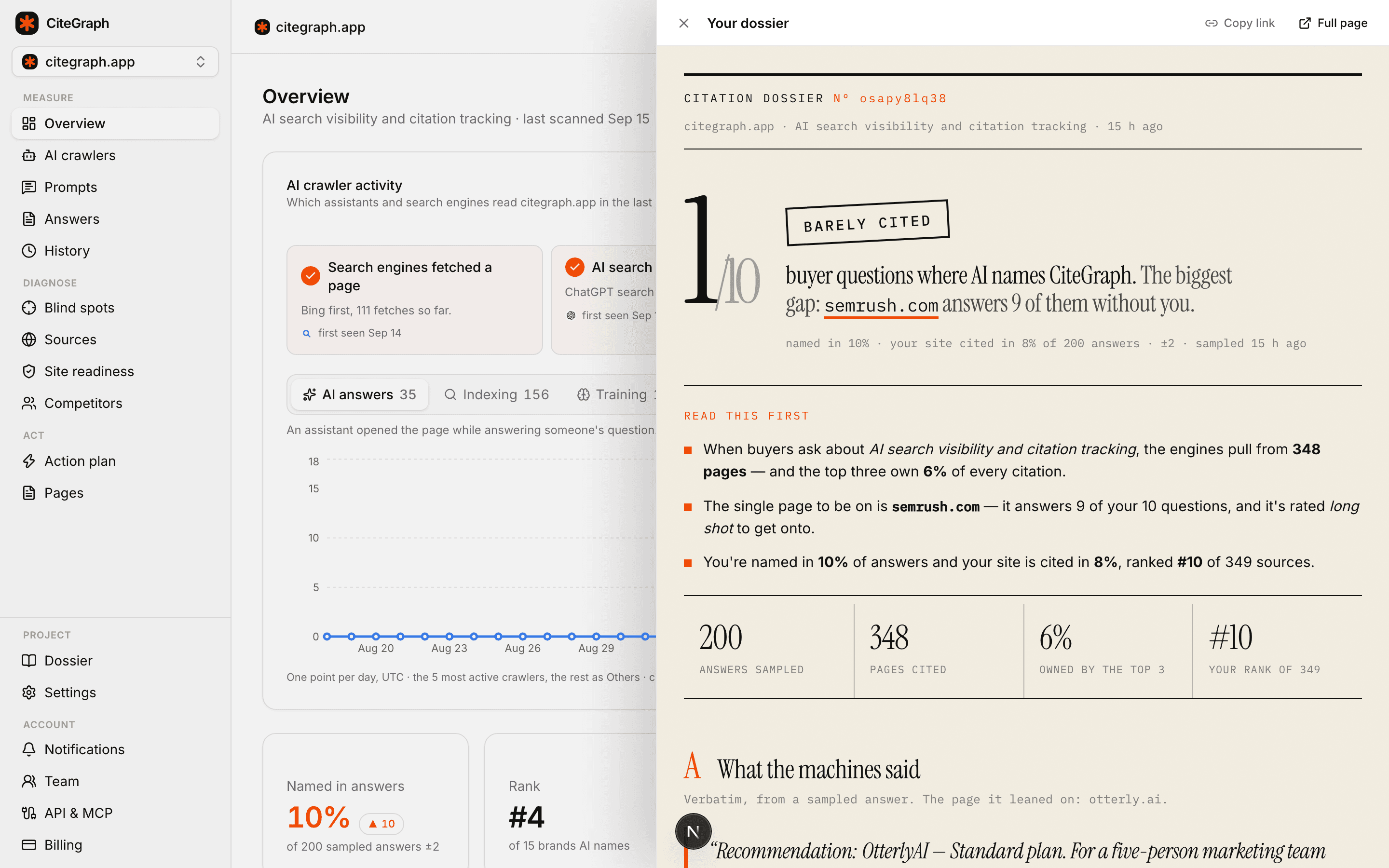
The ranked map of who owns your category's answers, every answer you're missing from, and the plays to take their spot.
How often the engines name you, with the margin printed, and who they name instead.
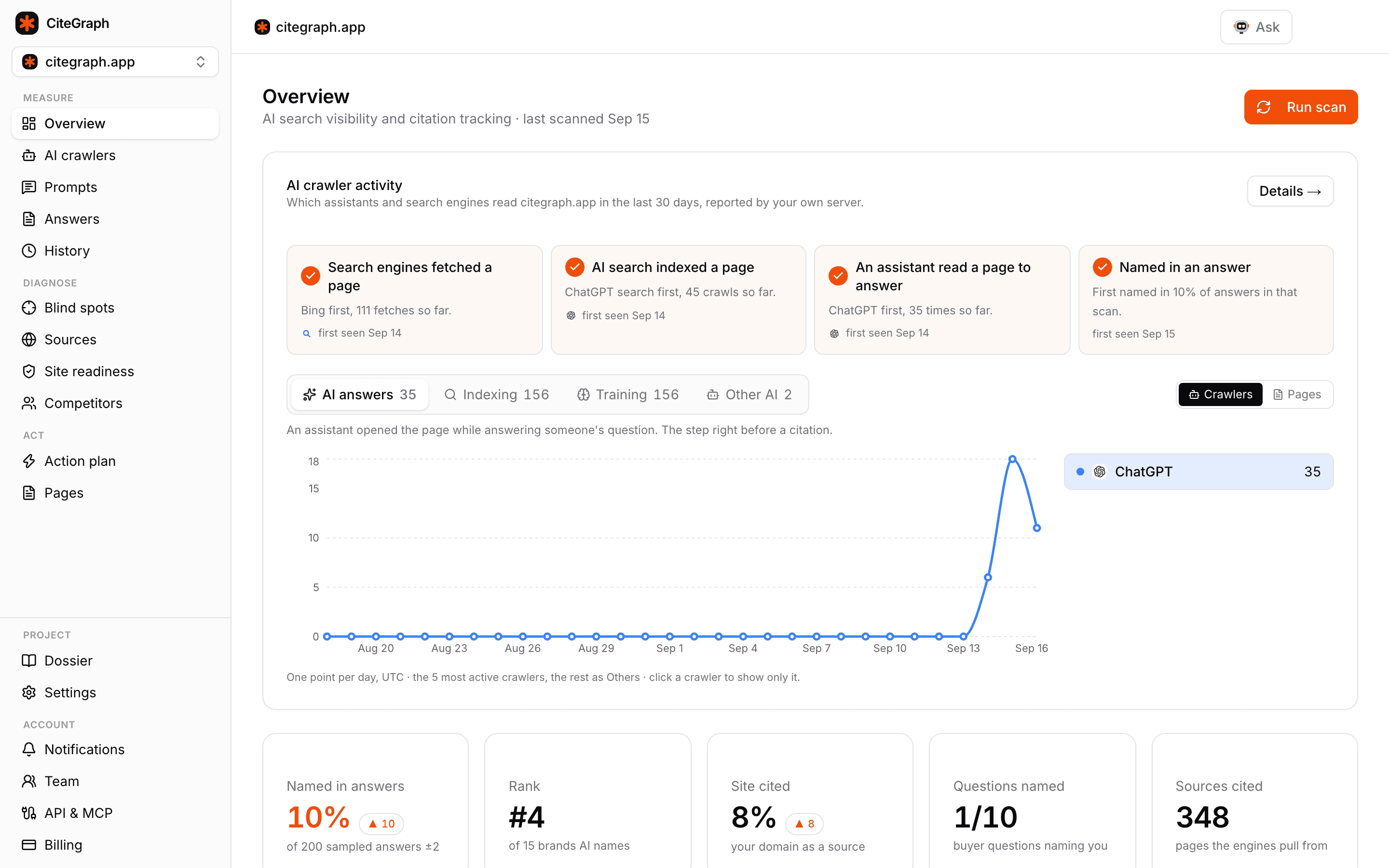
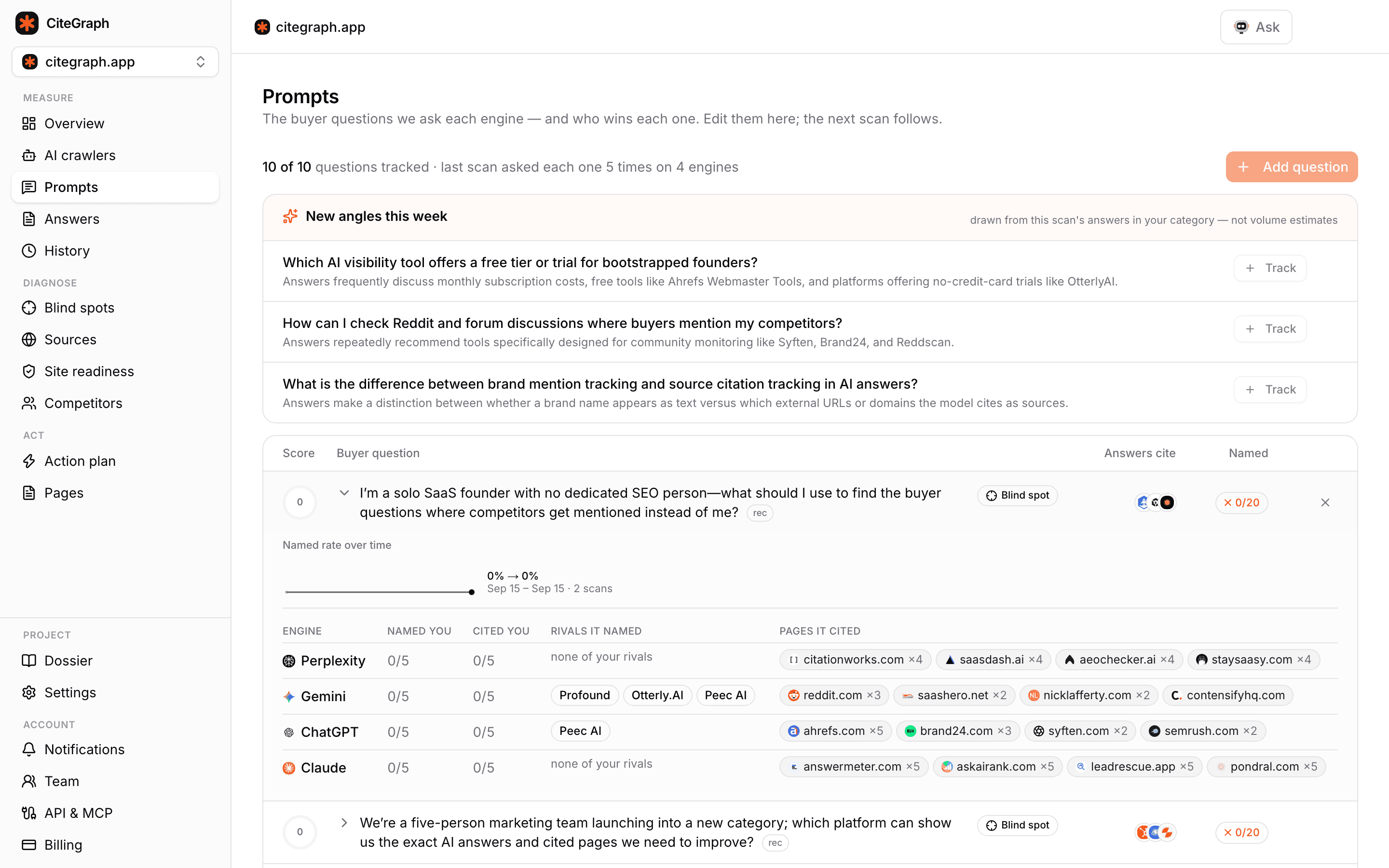
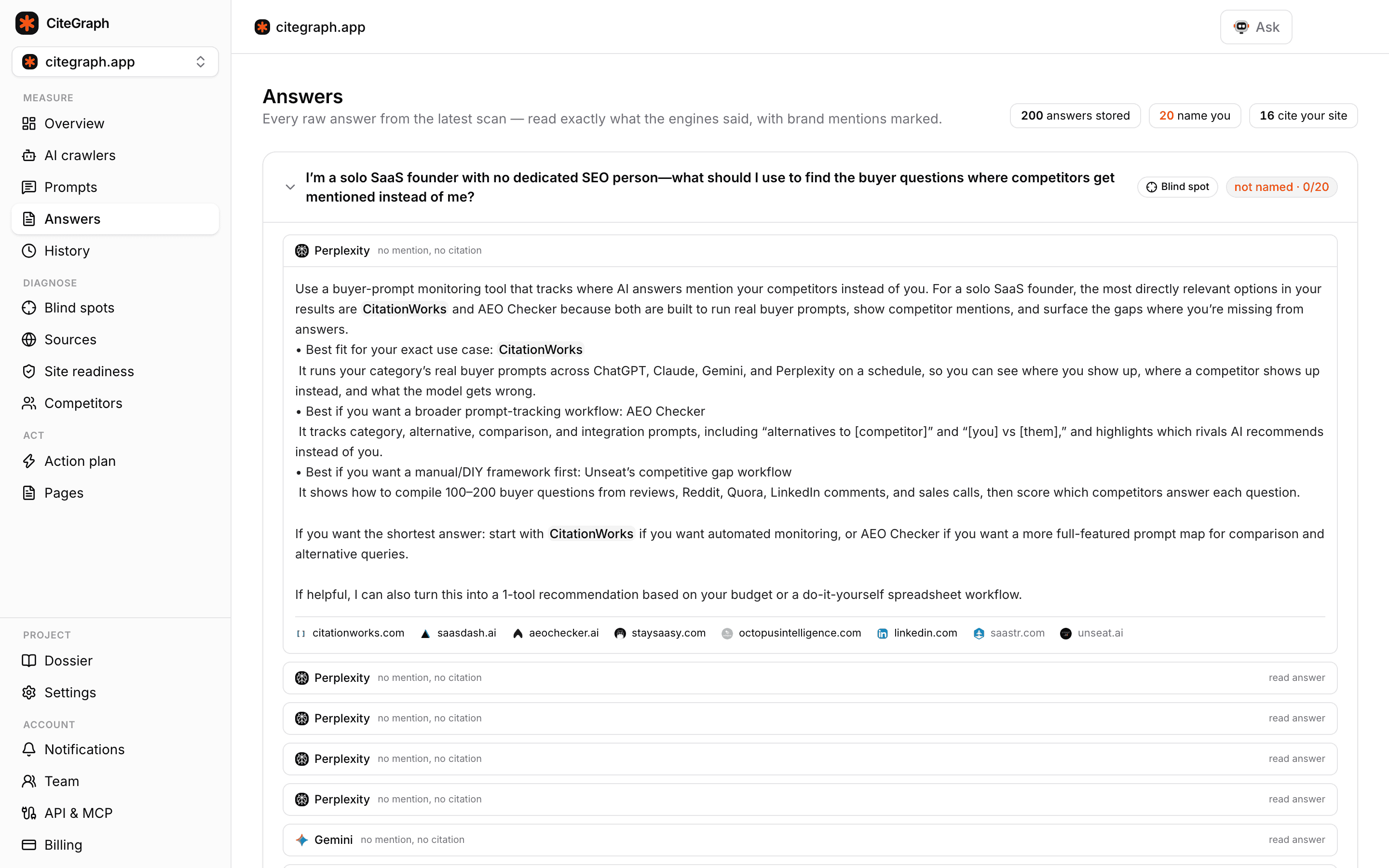
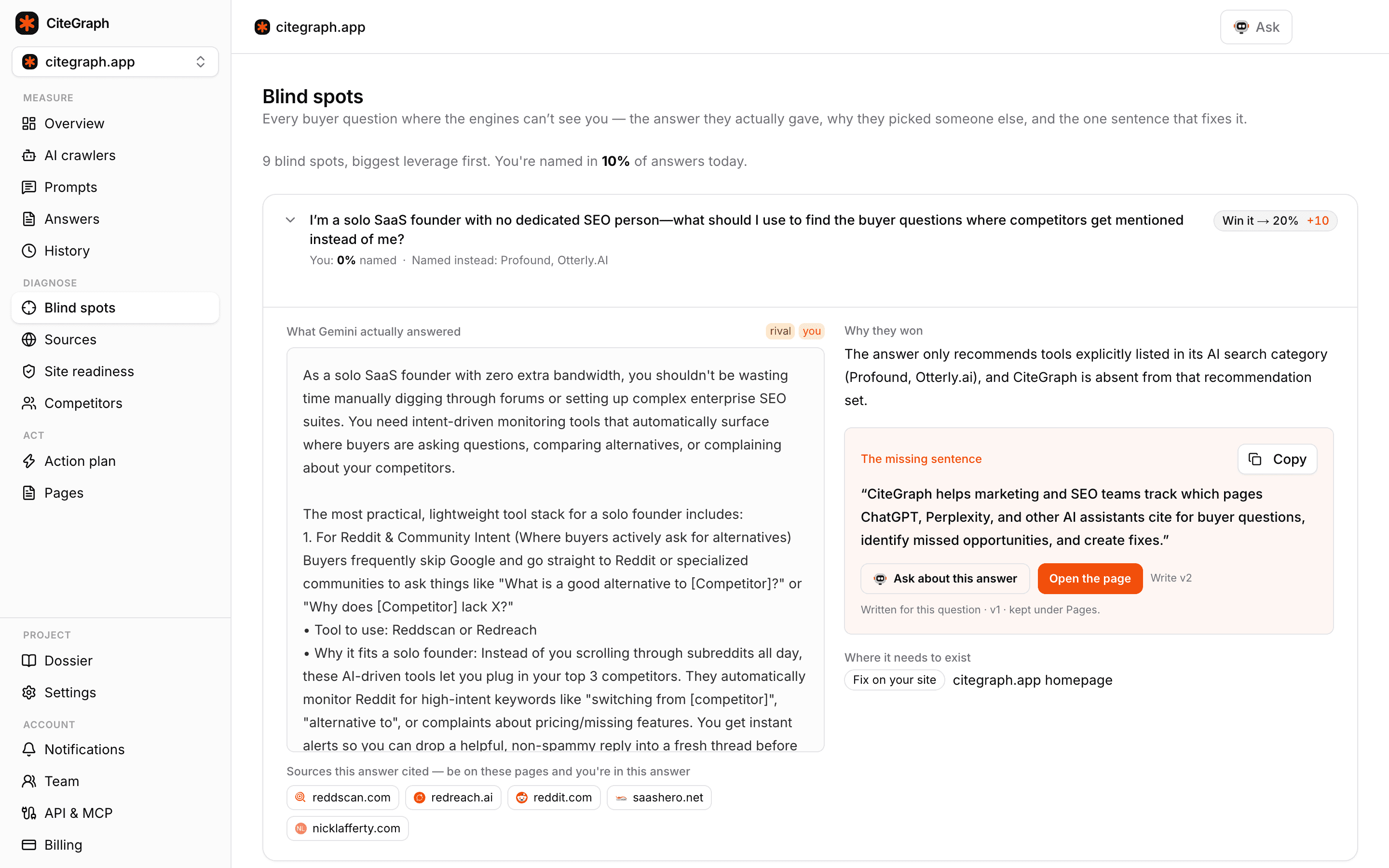
Swipe the screen to see more →
Everyone else tells you your score. CiteGraph shows you the answer you lost — and hands you the fix.
See the exact answer you lost
For every buyer question the engines skip you on: the verbatim answer, the rivals it named, and the reason it picked them. No score can tell you that. The answer can.
Get the sentence that wins it back
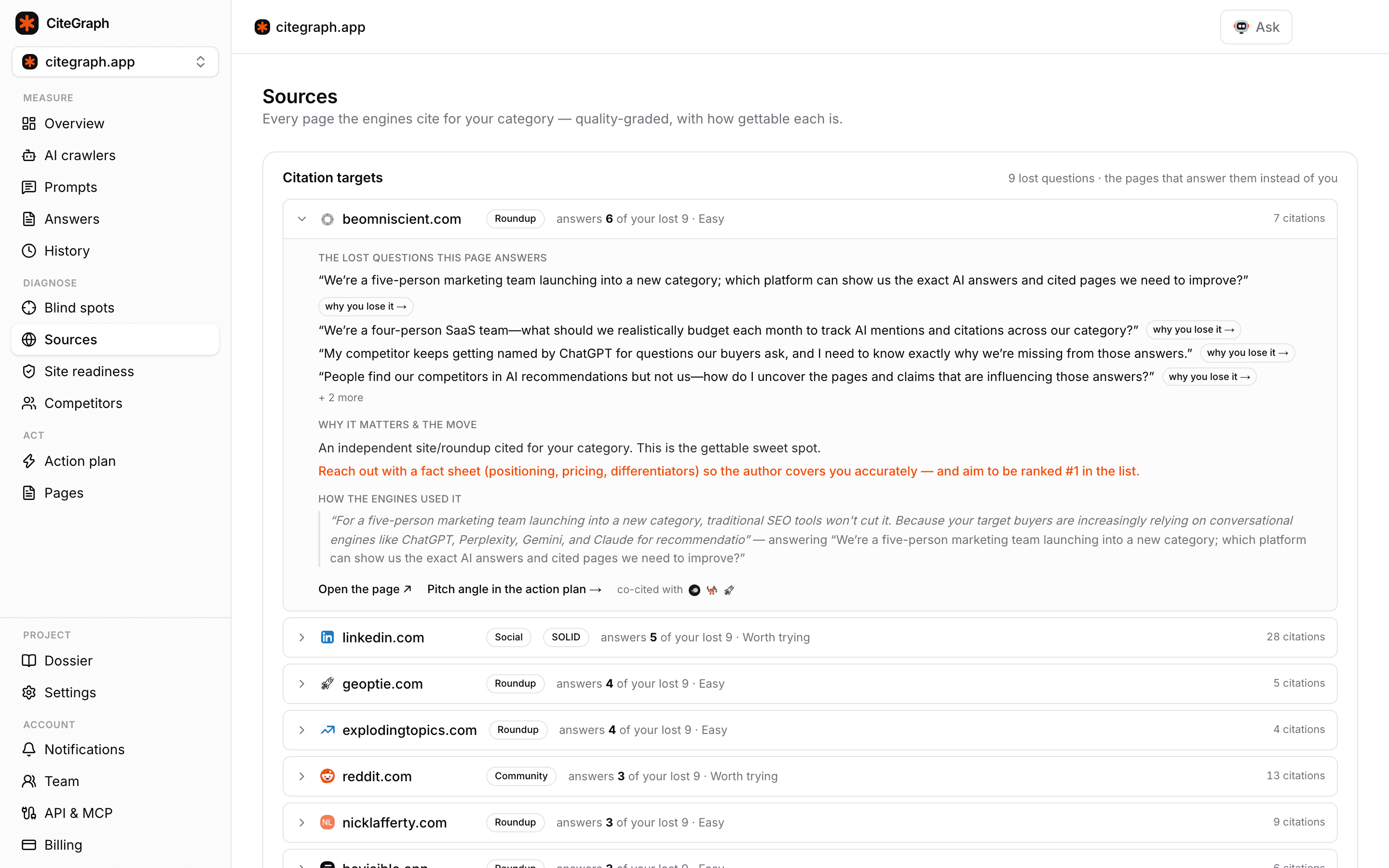
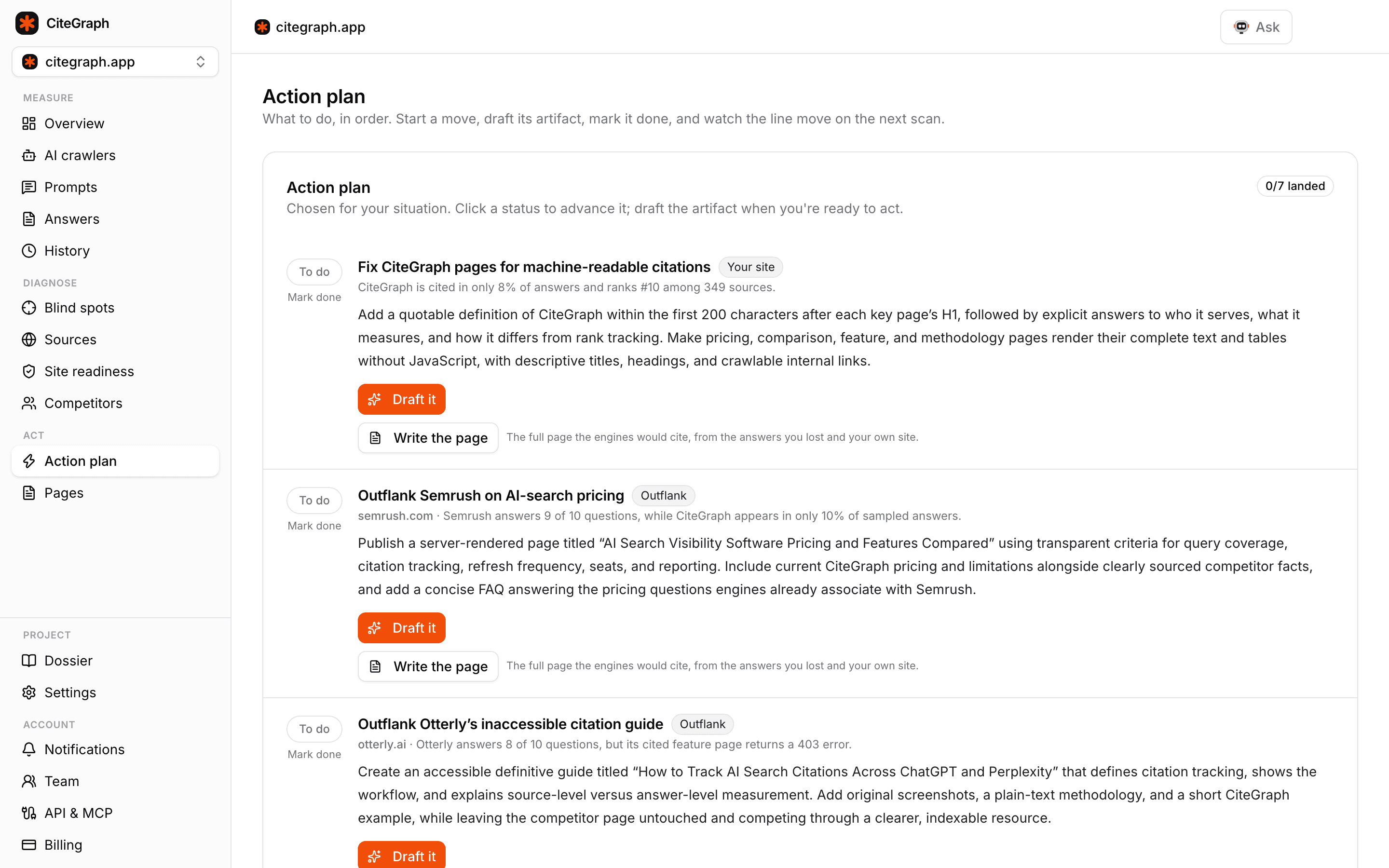
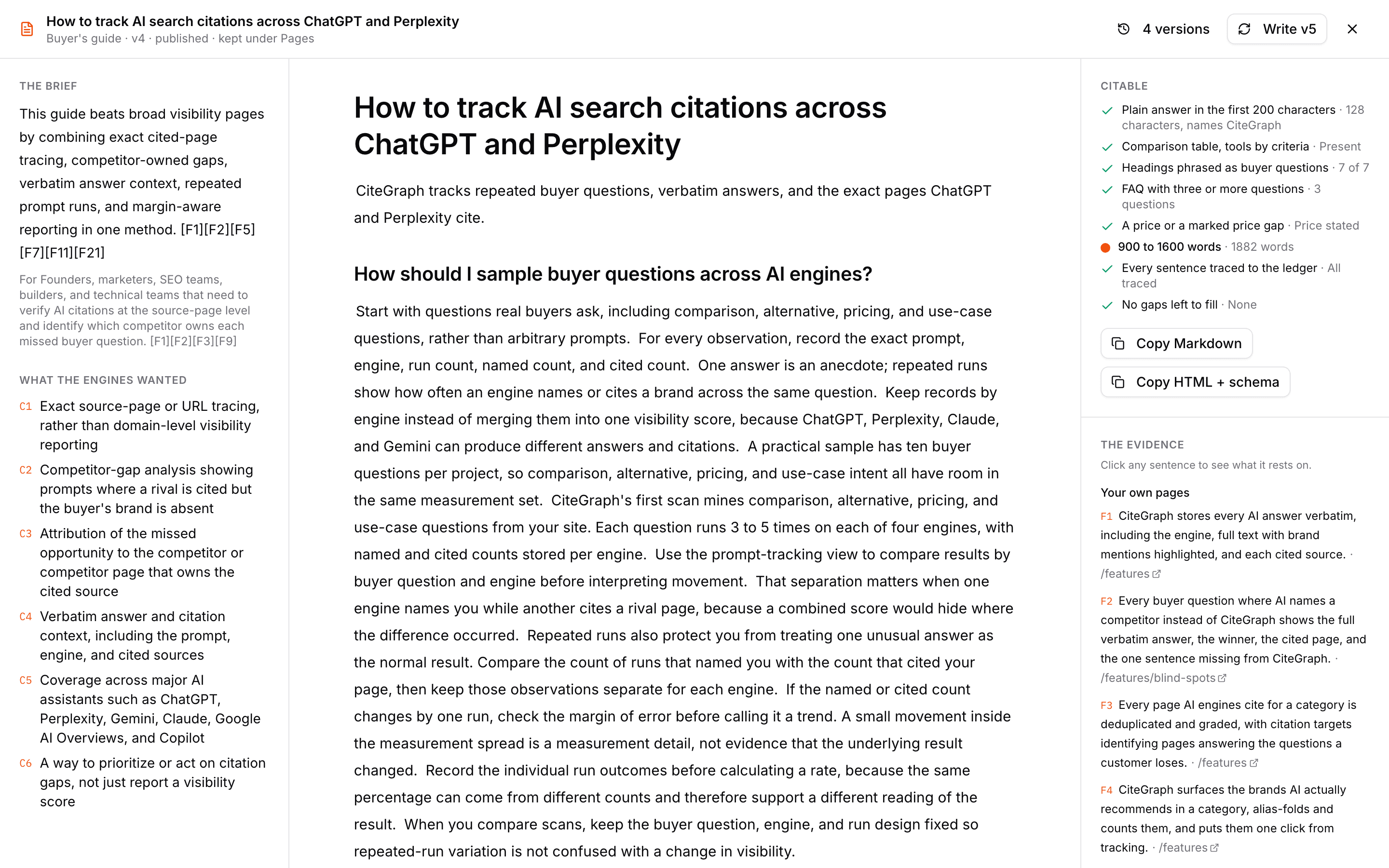
Each loss comes with the one claim that would have put you in the answer, where it needs to live, and the page that wins it: written from the answers you lost and your own site, every sentence traced to its source, in your voice.
Know who really owns your category
The pages every engine pulls from, graded by what they actually say about you — and flagged when a competitor owns them. You stop pitching the wrong page on day one.
Watch who gets named instead of you
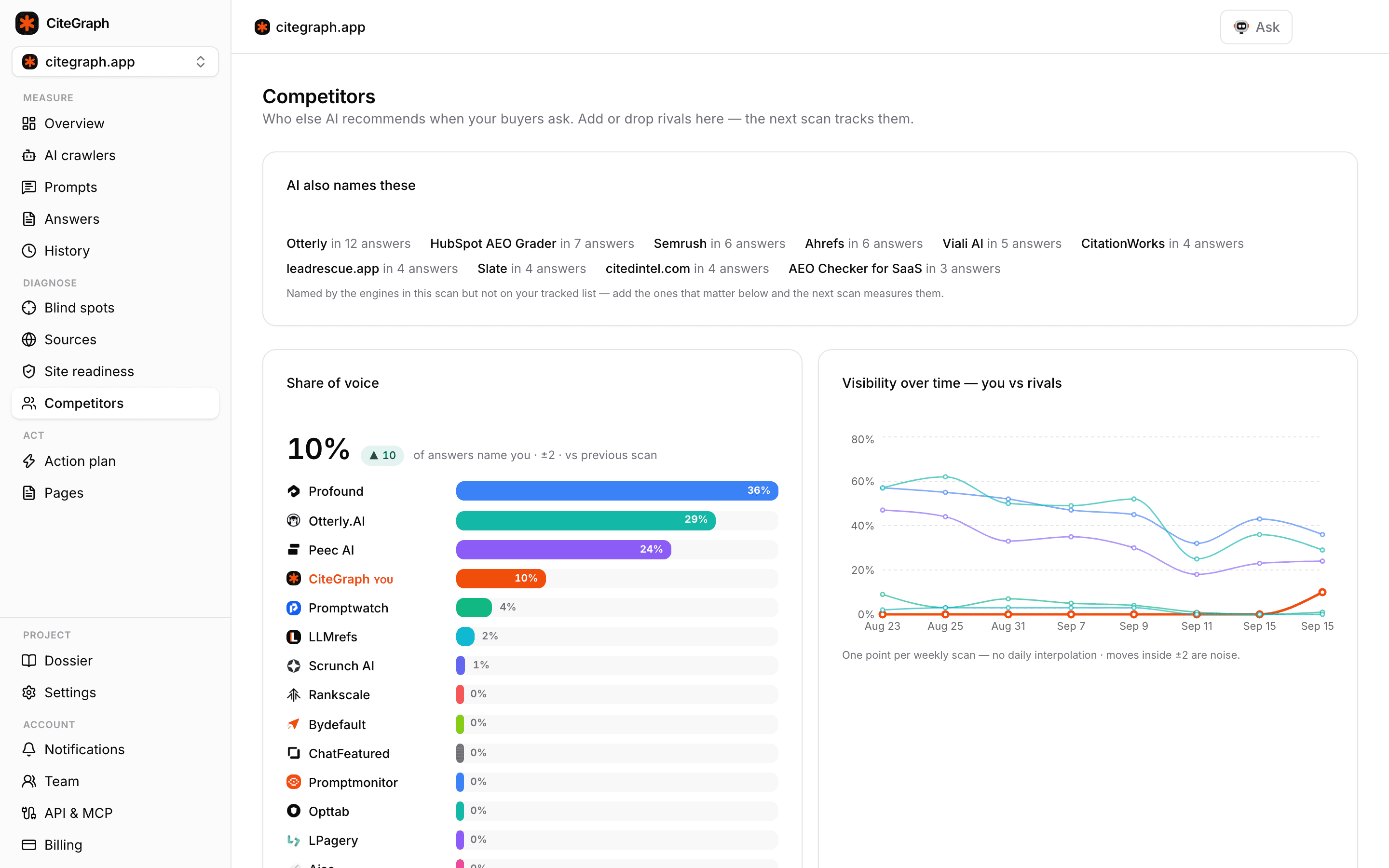
Share of voice across the rivals you choose, on the questions that matter, every scan. When a new name shows up in your answers, you know before your customers do.
Prove it moved
Weekly re-scans with the margin printed on every number, so a move is real before you tell your team. Digests only when something actually changed.
Asked the way buyers ask
Not keywords. Ten questions written like your buyers type them — compare, cheapest, alternative-to, use-case — each one run three times on four engines. Edit them any time.
Ask it, or hand it to your agent
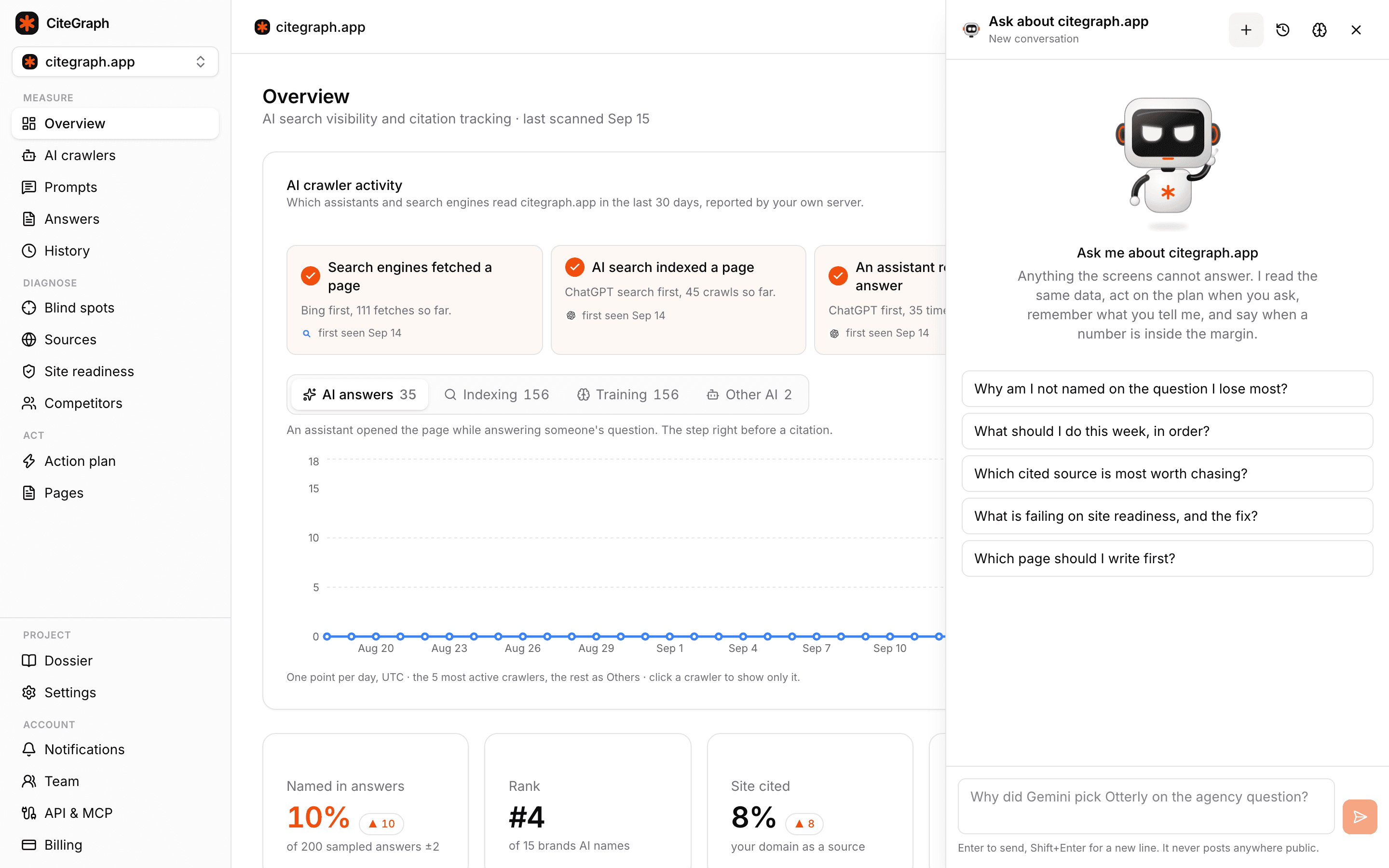
Ask reads your scan, blind spots, sources and readiness, answers in plain words, acts on the plan when you say so, and remembers what you tell it. The same tools run as an MCP server, so Claude, Cursor or VS Code can read your blind spots and apply the readiness fixes in your repo.
llms.txt does nothing. We checked. Competitors sell generators for it anyway.
Your mention rate is a vanity metric — the cited-source map is what you can act on.
One run is noise. Every number here is sampled, with its error bar printed.
Rank can’t be bought. Our own product is not on our own leaderboard. We published it anyway.
Plain answers, including the ones that cost us money.
What is answer engine optimization (AEO)?+
Answer engine optimization is the practice of getting your product named, and your pages cited, inside the answers AI assistants give — ChatGPT, Perplexity, Gemini and the rest — rather than inside a list of blue links. It differs from SEO in what it optimizes for: an answer engine reads a handful of pages and writes one recommendation, so the goal is to be the source that recommendation is built from.
Can I see when ChatGPT cites my website?+
Yes, in two separate ways, and they answer different questions. Your own server can report every request an assistant makes to your pages, so you see ChatGPT opening a page to build an answer, verified against the IP ranges OpenAI publishes. That tells you what was read. Separately, asking the engines your buyers' questions on a schedule and recording the sources in each answer tells you what was cited. Being read is not being named, but nothing gets named without being read. CiteGraph does both: a tracker you install on your site, and repeated scans across four engines.
How does ChatGPT decide which websites to mention in its answers?+
It retrieves a handful of pages at answer time and writes a recommendation from what they say. So the pages that get mentioned are the ones that state a usable claim plainly: a price, a limit, who it is for. Most of the pages an assistant cites when recommending a product are not the brand's own, which is why listicles, forums and review sites often carry more weight than a homepage. Getting mentioned is less about your own site and more about being on the pages the engine already trusts for that question.
How do I get ChatGPT to recommend my product?+
Find the buyer questions where an assistant already answers without you, read the pages it cited to build that answer, and get the missing claim about your product onto one of those pages — or onto a page of your own that answers the question better. CiteGraph measures which questions you lose, shows the verbatim answer and the cited sources, and writes the specific sentence that would have qualified you.
Does llms.txt help you get cited by AI?+
No. We tested it and found no measurable effect on citation rates. Assistants cite pages they retrieve and read at answer time; a manifest file at your root is not part of that path. Several tools sell llms.txt generators anyway. We say this publicly because it costs us nothing to be honest about it.
Is being mentioned by AI the same as being cited?+
No, and the difference matters. A mention means the assistant named your product in its prose. A citation means your own page was used as a source. In our measurements, 44% of the pages cited when recommending a product belong to somebody else — so a product can be recommended constantly while its own words never reach the buyer. Mention rate is the vanity metric; the cited-source map is the actionable one.
How does CiteGraph measure AI visibility?+
We write ten buyer questions for your category, ask each one three times on four AI engines through their official APIs, and record which products are named and which URLs are cited. Rates are sampled, so every number is published with its margin of error, and we only flag a change when it moves beyond that margin. Nothing is scraped from a chat UI and nothing is simulated.
How much does CiteGraph cost?+
Signing up shows you a site readiness score and one live AI answer on your own domain for nothing. Your first full scan runs the moment you pick a plan and add a card, with nothing charged for 7 days. Plans start at $29 a month for weekly tracking of two domains; Growth is $69 and Scale $149, and every plan carries a 120-day money-back guarantee. Without a plan, a scan is $12 with no subscription (your first purchase gets 2). There is no ongoing free tier because each scan spends real API money on live engine calls.
What if AI still doesn't mention me after using CiteGraph?+
Then you get your money back. Every paid plan carries a 120-day guarantee: if no CiteGraph scan shows ChatGPT, Claude, Gemini or Perplexity naming your product within 120 days of your first payment, we refund every subscription payment from those days. Your side is to keep the plan and weekly scans on and publish three of the pages CiteGraph writes for the questions you lose. It is checked from your own scan history; the full terms are at citegraph.app/terms.
Can I pay to rank higher on CiteGraph's leaderboards?+
No. Positions on the public category leaderboards are measured from engine answers and cannot be bought, boosted or edited by anyone, including us. There are no sponsored rows and no featured slots. CiteGraph itself does not appear in its own AI search visibility leaderboard, and we published that anyway.
Which AI engines does CiteGraph track?+
Three production answer engines are queried for every scan through their official grounded-search APIs, so results reflect what a real buyer would see rather than a cached index. Each question is run multiple times per engine because answers vary between runs, and the per-engine breakdown is shown alongside the blended rate.
The only tool that shows you the answer you lost, the reason, and the sentence that wins it back. One plan, every engine, receipts on everything.
AI is recommending someone else.
- Ten buyer questions, asked three times each on four engines, every answer kept verbatim
- Each answer you lost: who it named instead, the page it leaned on, and the sentence yours is missing
- Fifteen site checks with the fix to paste, and a second scan to prove it moved
- ✓Projects (domains)2
- ✓Buyer questions per project10
- ✓Runs per question3
- ✓AI engines4
- ✓Scan cadenceWeekly
- ✓Blind spots — lost answers, verbatim
- ✓Plays & AI-drafted artifacts
- ✓Pages written for lost questions30 / month
- ✓Ask: the assistant on your scan
- ✓MCP server, API keys, Claude.ai connector
- ✓Competitor share of voice6 rivals
- ✓Per-engine breakdown & history
- —Fact sheets for writers
- ✓Weekly digest emails
- ✓Public dossier link
- —Priority scan queue
- —CSV export
- ✓Seats1
- ✓Projects (domains)3
- ✓Buyer questions per project10
- ✓Runs per question5
- ✓AI engines4
- ✓Scan cadenceWeekly
- ✓Blind spots — lost answers, verbatim
- ✓Plays & AI-drafted artifacts
- ✓Pages written for lost questions60 / month
- ✓Ask: the assistant on your scan
- ✓MCP server, API keys, Claude.ai connector
- ✓Competitor share of voice10 rivals
- ✓Per-engine breakdown & history
- ✓Fact sheets for writers
- ✓Weekly digest emails
- ✓Public dossier link
- —Priority scan queue
- ✓CSV export
- ✓Seats5
- ✓Projects (domains)6
- ✓Buyer questions per project10
- ✓Runs per question5
- ✓AI engines4
- ✓Scan cadenceWeekly · priority
- ✓Blind spots — lost answers, verbatim
- ✓Plays & AI-drafted artifacts
- ✓Pages written for lost questions200 / month
- ✓Ask: the assistant on your scan
- ✓MCP server, API keys, Claude.ai connector
- ✓Competitor share of voice10 rivals
- ✓Per-engine breakdown & history
- ✓Fact sheets for writers
- ✓Weekly digest emails
- ✓Public dossier linkWhite-label
- ✓Priority scan queue
- ✓CSV export
- ✓SeatsUnlimited
Named by an AI assistant within 120 days, or every payment back.
Keep your plan and weekly scans on, and publish three of the pages CiteGraph writes for you. If no scan in your first 120 paid days shows ChatGPT, Claude, Gemini or Perplexity naming you, we refund every subscription payment. Terms
Full plan limits and pricing FAQ → · Something custom — enterprise terms, more seats, an API: info@citegraph.app
Start free: we ask an AI assistant a real buyer question in your category, then show you whether it names you and who it names instead.
Check your site →CiteGraph is an AI search visibility and citation tracking tool for founders, marketers and SEO teams. It runs the questions buyers ask through ChatGPT, Claude, Gemini and Perplexity, shows every answer and the pages the engines cite, and gives the fixes to win those citations. Plans start at $29 a month with a 7-day trial and a 120-day money-back guarantee; a single scan is $12. Alternatives it is compared with: Profound, Otterly.AI, Peec AI, Scrunch AI, Rankscale, CrowdReply and Bydefault.